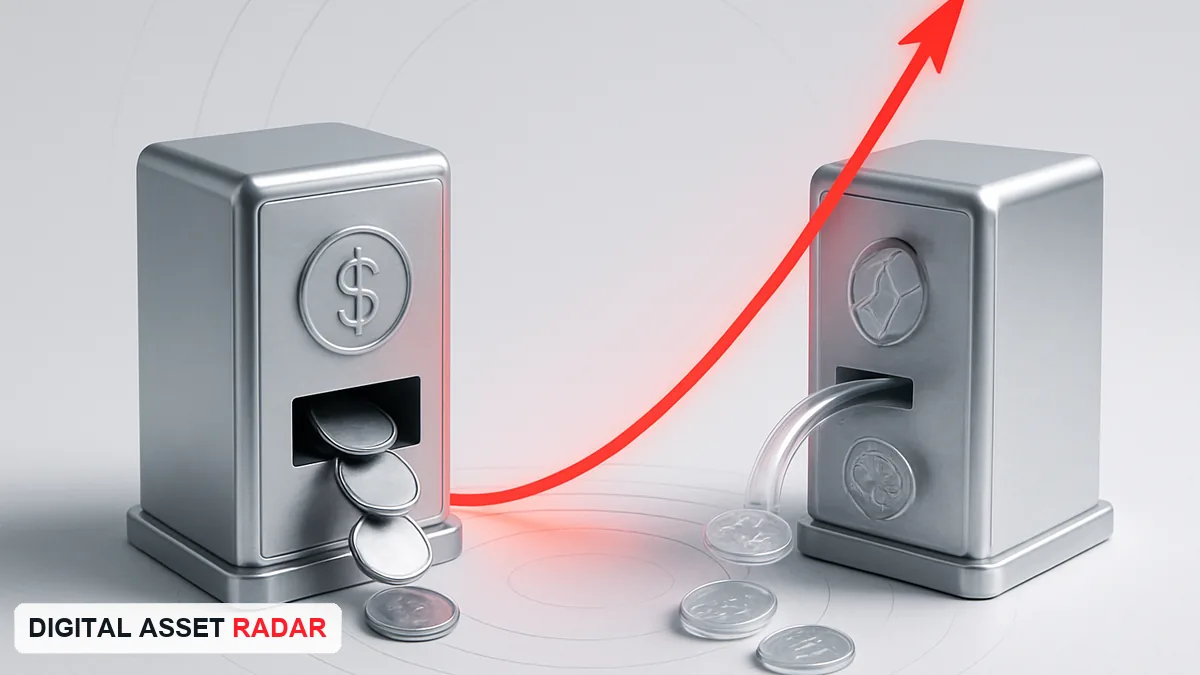
Prediction markets let anyone price the probability of a future event — an election, a rate cut, a hurricane, a Bitcoin move — and get paid for being right. In a conversation with Raoul Pal, Kalshi co-founder and CEO Tarek Mansour argues that these markets are quietly becoming a “new Wall Street”: a truth-seeking machine that democratizes forecasting, prices things the incumbents never could, and now runs regulated crypto perpetuals on U.S. soil.
Here is the argument stripped of the hype and rebuilt into what it actually claims — where prediction markets are genuinely disruptive, where the model is still unproven, and why crypto traders, not sports bettors, are driving the growth.
Key takeaways
- Kalshi’s thesis is that markets find truth better than experts — a regulated venue where being right pays and being loud loses, the opposite incentive structure to social media.
- Superforecasters beat domain experts. The best inflation forecaster on the platform is “a random dude in Kansas,” not a Wall Street economist — because expertise carries bias.
- Perpetuals are the fastest-growing product Kalshi has ever launched, and crypto is its fastest-growing category — up 25x since the start of 2026.
- The bigger vision is “infinite markets” — pricing every discrete factor (AI, politics, geopolitics) independently and feeding it back into traditional asset prices.
- Regulation is the moat and the battleground. Kalshi sued the U.S. government to exist, and incumbents are now suing regulators over perpetuals — which Mansour reads as a bullish signal.
Why traditional markets are “broken”
Mansour’s starting point is that most financial instruments are indirect. When you want to bet that Trump wins or Brexit happens, you don’t have a clean way to do it — so you express the view through a proxy like a short on the S&P. The problem, as he puts it, is that “people were right about the prediction and then they lost money.” The proxy carried too much unrelated noise, or basis risk.
Prediction markets collapse that layer of indirection. Instead of decomposing a stock trade into “earnings will beat” plus “Elon stays” plus a dozen macro factors, you trade the factor you actually care about. It is cleaner, less noisy, and — crucially — it strips out the chain of intermediaries that each take a cut. A credit default swap needs a wealth adviser, a trade executor, and a regulatory wrapper; a simple yes/no market does not.
This connects to a piece Mansour cites from Kevin Hassett on “infinite markets”: society needs an ever-growing number of markets to keep allocating resources efficiently. To price the S&P or home prices accurately over a long horizon, you need a view on AI, politics, and geopolitics. Prediction markets let you price each of those dimensions independently and feed the signal back into traditional prices — fighting the entropy that otherwise builds up.
The knowledge problem, and why markets find truth
The intellectual backbone here is Friedrich Hayek’s 1945 “knowledge problem”: decisions are made centrally, but the relevant information is distributed, dynamic, and local. Market prices are the proven mechanism for surfacing that scattered knowledge — open a free market on a question, and information trickles up into a single number.
Kalshi’s claim is that this actually works empirically. Mansour points to Federal Reserve calibration data showing that when the market says something has an 80% chance of happening, it happens about 80% of the time. That reliability is why more than 80% of active users don’t trade at all — they treat the platform as a newsfeed, reading probabilities the way others read headlines. In a world of echo chambers where “people don’t believe anything anymore,” a number backed by people with skin in the game becomes a source of truth.
The incentive structure is the inverse of social media. A boring, down-the-middle take gets ignored on Twitter but makes money in a prediction market; an extreme, over-confident take goes viral online but generally loses money. Kalshi’s American Power Index — pitched as “the S&P for politics” — aggregates thousands of these discrete election markets into a single measure that oscillates between the parties, a mathematical read on where the country is heading instead of a vibe from your feed.
Superforecasters versus the experts
The most counterintuitive finding is that domain expertise doesn’t predict who forecasts well. Drawing on Philip Tetlock’s Superforecasting, Mansour notes that self-selected, calibrated generalists tend to outperform credentialed experts once they’ve done the work — because the experts carry the biases baked into their careers. Bloomberg’s panel of 15 economists all bring the same professional priors; a crowd of superforecasters amalgamates into something closer to the truth.
These winners aren’t the usual suspects. Across gender, age, income, and Ivy-League pedigree there is no clear pattern — just some “curiosity gene” and a willingness to unbias yourself over years. Mechanically, they trade fair value rather than direction: if they think an event is 65% likely, they buy below 62% and sell above 67%, and that constant arbitrage back to fair value is what keeps the whole market calibrated.
Mansour also flags where the crowd predictably breaks. Around the 50% mark, calibration deviates — because humans default to “50/50” when they simply lack information (a high-entropy state), not because the odds are genuinely even. It’s exactly the framing error that led markets to treat COVID as a 1% event in December 2019 when it was closer to a 10–20% event.
Why crypto traders are driving the growth
Kalshi didn’t start as a crypto company and doesn’t call itself one — yet as of July 2026, crypto is its fastest-growing category, up 25x since the start of the year. The launch of regulated perpetual futures (“perps”) is the fastest-growing product in the company’s history.
The appeal is structural. Perpetuals have no expiry, which suits how people actually think: someone believes Bitcoin goes up “for now” and exits when the view plays out — they rarely think “Bitcoin rises until the end of July.” A monthly future forces you to roll the position and pay fees six times over a six-month view; a perp doesn’t. Longs and shorts are symmetric, so retail can short Bitcoin as easily as going long. And critically, Kalshi’s perps use the same “boring” risk methodology as CME — no exotic 200x leverage, just normalized volatility inside a regulated U.S. wrapper that gives users a regulator to call if something breaks.
This is the same speedrun dynamic crypto is known for: the industry takes a theoretical concept — Robert Shiller proposed perpetuals in the 1990s — and forces it into practical reality. Offshore venues like Hyperliquid proved the demand; Kalshi’s playbook is to bring that onshore the regulated way. The macro backdrop for why derivatives keep eating spot volume is one we explore in our economic singularity 2030 thesis.
Anyone can become a hedge fund
The broader vision is unbundling asset management itself. If a trader on Kalshi can build a verifiable track record forecasting inflation or politics, they don’t need Millennium’s legal structure, capital allocation machinery, or operational overhead to run money. Raoul Pal frames it as buying a “token” that gives economic exposure to a forecaster’s performance — collapsing the entire pod structure of a multi-manager fund into direct, real-time allocation across dozens of individual talents.
The edge comes from widening the instrument universe. Most retail traders can’t beat hedge funds’ information asymmetry on S&P options — but they can win forecasting inflation, politics, sports, or culture, arenas where Wall Street has no natural edge. Some of these forecasters have already graduated from hobbyists to full-time operators raising external money, because their results speak for themselves. This democratization thread — retail and AI reshaping who gets to participate — runs through our analysis of Reed’s Law and the exponential age.
Regulation as moat and battleground
None of this is easy. Kalshi spent four years getting regulated and ultimately had to sue the U.S. government to force the issue — “very hard to sue the government and ask the government to rule against itself,” Mansour notes. His philosophy is pro-regulation with a metaphor: build a highway wide enough for innovators to thrive, but put up a fence so people don’t fall off the cliff.
The uncomfortable reality is that much regulation is really incumbent protection — decades of lobbying and regulatory capture dressed up as consumer safety. The tell: the CFTC was sued over its approval of Kalshi’s perpetuals, and Mansour reads an incumbent litigating against a product, rather than competing with it, as a bullish signal. Rollover fees are roughly 20% of some futures venues’ revenue, and perps threaten exactly that stream.
The endgame: a global information market
Beyond trading, Kalshi is sitting on a uniquely valuable asset — a forward-looking dataset of falsifiable predictions across an enormous diversity of topics, with the outcomes attached. That’s rocket fuel for AI: models need the feedback of “did the prediction hit?” to learn, and few datasets capture that at Kalshi’s breadth. For now the company gives its data away to grow adoption; Mansour openly hints that could change.
Pal’s framing is that Kalshi is building a “token factory” of global probabilities — an information market that becomes more valuable as civilization-scale AI demands ever more priced, verifiable signal. Banks are already embracing prediction-market data faster than they embraced crypto, and over-the-counter markets like weather and hurricane insurance are moving on-exchange, where transparent pricing has historically expanded volumes 10–50x. For readers new to this space, our digital asset guides cover the fundamentals of how these markets work.
The bottom line
The prediction-market thesis is genuinely strong where it’s structural: the knowledge problem is real, calibration data suggests these markets do find truth, and perpetuals are a cleaner product than the futures they compete with. It’s more speculative where it’s promotional — the “anyone can become a hedge fund” pitch still runs into survivorship bias, and the data-monetization endgame is aspiration, not revenue.
But the direction of travel is hard to argue with. As more of the world gets priced probabilistically — and as regulated crypto perps pull derivative volume onshore — the line between a betting market and a financial market keeps blurring. That blur is exactly what Mansour means by the new Wall Street.
Frequently asked questions
What is Kalshi?
Kalshi is a CFTC-regulated U.S. exchange where users trade on the outcome of real-world events — elections, economic data, weather, crypto prices — via yes/no event contracts, and as of 2026, regulated perpetual futures. It was co-founded by CEO Tarek Mansour and spent four years securing regulatory approval, ultimately suing the U.S. government to operate its election markets.
Are prediction market odds actually accurate?
Broadly yes. Federal Reserve calibration data cited by Kalshi shows that events priced at 80% probability occur roughly 80% of the time. The main weak spot is around the 50% mark, where humans default to “50/50” as a stand-in for “I don’t know” rather than a genuine probability estimate.
What are perpetual futures and why do they matter?
Perpetual futures (“perps”) are derivative contracts with no expiry date, so traders can hold a position as long as their view lasts without rolling monthly contracts and paying repeat fees. Kalshi’s perps apply CME-style risk methodology inside a regulated U.S. venue — as of July 2026 they are the fastest-growing product in the company’s history.
This article is analysis and commentary, not investment advice. Do your own research.